
Most of what you read about AI for small business is either hype or homework. You want neither. You want to know, concretely, where AI can help small businesses do more work without hiring, and where it just adds noise. So here are 12 real use cases, each tied to a result you can measure: time you get back, leads you stop losing, work you stop redoing.
No magic. AI here means software that handles the repetitive, decision-light parts of your day so you can spend your hours on the parts that actually need you.
1. Respond to new leads in seconds
When someone fills out your form at 9 p.m., the business that replies first usually wins. You’re asleep. An AI responder isn’t. It can answer the moment a lead comes in, acknowledge their message, ask one or two qualifying questions, and hand you a warm contact instead of a cold one you have to chase the next morning. The mechanism is simple: speed-to-lead is the cheapest advantage you have, and software never gets tired.
2. Book appointments without the back-and-forth
The “are you free Tuesday?” / “no, Wednesday?” loop quietly eats hours. An AI scheduling layer reads your calendar, offers real open slots, and confirms the booking. The lead picks a time, the time lands on your calendar, and nobody played email tag. You wake up to a booked day, not a backlog of replies to send.
3. Draft first versions of your content
A blank page is expensive. AI is good at the first 80% — turning your bullet points into a draft email, a service-page section, a set of social captions. You’re not publishing the raw output; you’re editing instead of starting cold. The job changes from “write this” to “fix this,” which is a fraction of the time.

4. Follow up with leads on autopilot
Most sales are lost in the gap after the first conversation, when nobody follows up. AI can run that sequence for you: a reminder a day later, a check-in after three days, a last nudge after a week, each one written like a person and stopped automatically the moment the lead replies or books. You stop leaving money in the follow-up gap without lifting a finger.
5. Handle routine customer questions
“What are your hours?” “Do you service my area?” “How much for X?” The same handful of questions, over and over. An AI assistant on your site or messages can answer them instantly, around the clock, and only pass the real conversations to you. Your customers get an answer now; you get your evenings back.
6. Qualify leads before they reach you
Not every inquiry is worth your time, and figuring out which ones are is itself work. AI can ask the qualifying questions up front — budget, timeline, location, what they actually need — and sort the serious buyers from the tire-kickers. You spend your selling time on people ready to buy instead of explaining your prices to someone who was never going to.
7. Turn one piece of content into ten
You wrote a blog post or recorded a video. AI can repurpose it into an email, a set of social posts, a short summary, a FAQ entry — without you starting from scratch each time. One idea, many formats, one tenth of the effort. This is also a core part of using AI for marketing on social media, where the bottleneck is almost always volume.
8. Summarize calls, emails, and meetings
The notes you meant to take but didn’t. AI can transcribe a call, pull out the action items, and drop a clean summary where you’ll actually see it. Nothing falls through the cracks because someone forgot to write it down. You stay on top of every conversation without becoming your own secretary.
9. Sort and route your inbox
A flooded inbox hides the messages that matter. AI can read incoming email, flag the urgent ones, tag the leads, and surface what needs a human reply today. Instead of triaging 60 messages, you handle the 6 that move your business forward.
10. Build advertising creative faster
Testing ads means producing variations, and producing variations by hand is slow. AI ad tools can generate headlines, copy, and creative options quickly so you can test what works instead of betting everything on one guess. The point isn’t to replace strategy — it’s to remove the production bottleneck. We go deeper on the real tools in the best AI advertising tools in 2026.
11. Personalize follow-up at scale
Sending the same generic email to everyone gets ignored. AI can tailor the message to what each contact actually did — the service they asked about, the page they viewed, the last thing they said — so the follow-up feels written for them. Personalization used to mean more labor. Now it’s something a system can do across hundreds of contacts at once.
12. Spot patterns in your own data
You’re sitting on data you never look at: which services sell, which leads convert, what time people book, where money leaks. AI can read that data and tell you in plain language what’s working and what isn’t. You make decisions on evidence instead of gut feel, without learning to build a spreadsheet pivot table.
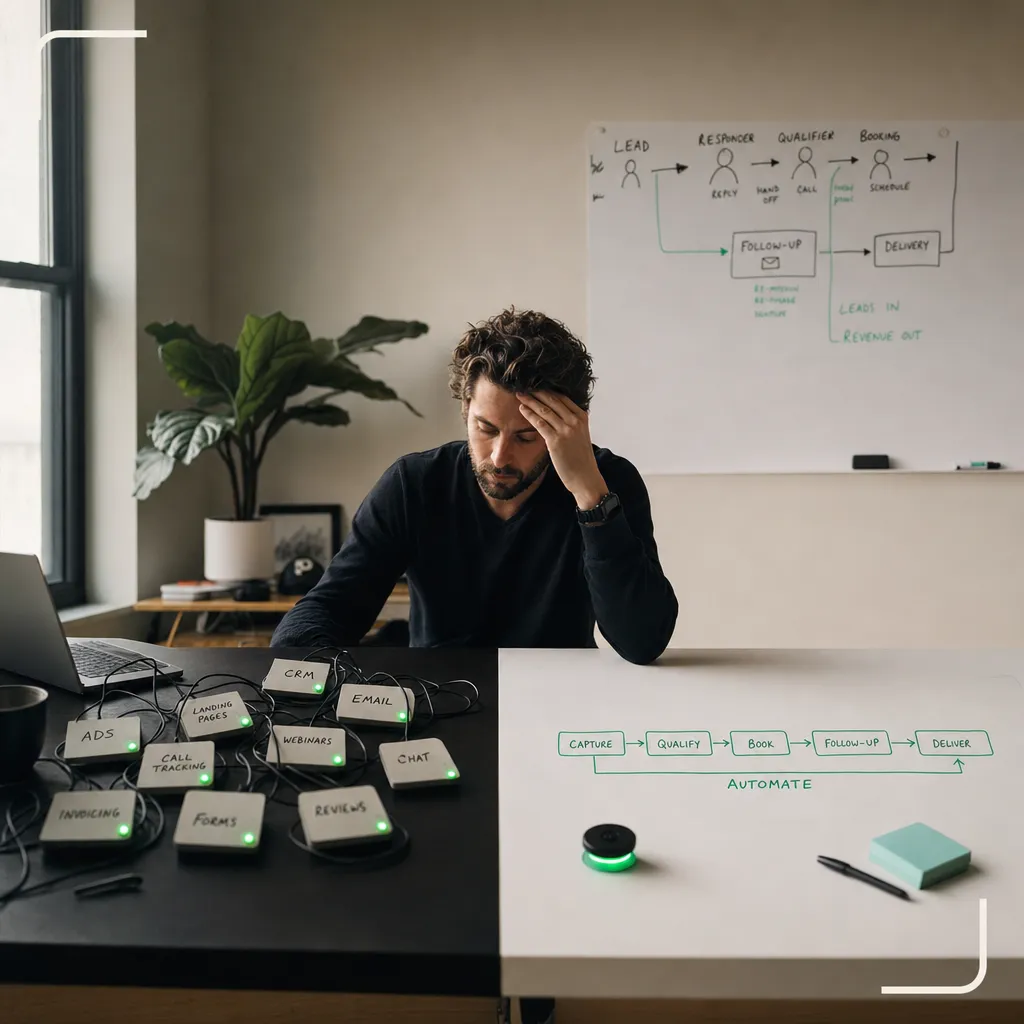
The catch: tools alone don’t fix anything
Here’s the honest part. Any one of these, bolted on by itself, gives you a small win and a new tab to manage. The real return shows up when they’re connected — when the AI responder hands the lead to the qualifier, which books the appointment, which triggers the follow-up, all without you touching it. That’s the difference between buying twelve gadgets and building one engine. If you want the strategy side first, start with how to use AI for your marketing before you start buying tools.
FAQ
Do I need to be technical to use AI in my business? No. The tools have gotten genuinely easy to use, and the parts that aren’t — connecting them into a working system — are exactly what a partner sets up for you. You should understand what the system does, not how to build it.
Will AI replace my team? For most small businesses, no. It replaces the repetitive tasks that burn your team’s time — data entry, first-draft writing, routine replies — so the people you have can do the work that actually needs a human. It’s a force multiplier, not a layoff.
Where should a small business start with AI? Start where you’re losing money or hours right now. For most owners that’s lead response and follow-up, because that’s where leads quietly slip away. Fix the leak first, then expand.
What does AI actually cost a small business? Most tools run on modest monthly subscriptions, but the figure that matters is return. If a follow-up system books two extra jobs a month, the math is obvious. Anchor the decision on what it earns back, not on the number on the invoice.
How is this different from just using ChatGPT? A chat tool helps you do one task faster when you sit down to use it. A connected AI system does the work on its own, in the background, triggered by what happens in your business. One is a helper you operate; the other is infrastructure that runs.
Tell us where your day actually goes — the chasing, the back-and-forth, the leads that go cold — and we’ll map which of these to automate first and how to wire them into one system. Book a free consultation with Argana and we’ll start with your biggest leak.